

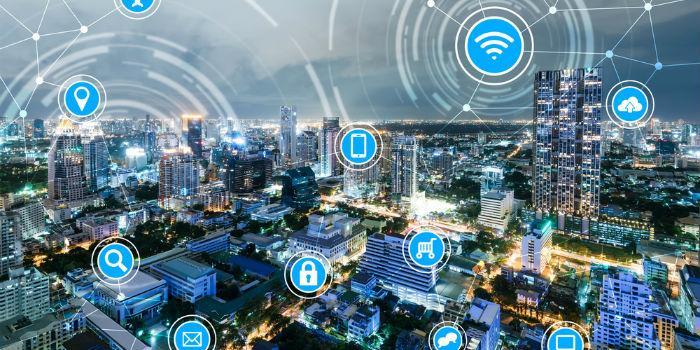
 Latin America. Just as "Internet of Things" (IoT) has boomed over the past 5 years, "Smart City" will be the next big buzzword. IoT sensors and devices are everywhere, and their applications are very varied, for example, in traffic management, dynamic parking lots, public Wi-Fi networks, smart meters, and public safety along with smart buildings, stadiums, and transit centers. However, there is no such thing as a smart city without efficient networks to connect IoT devices and applications.
"Smart cities will enrich the lives of residents and make local governments more efficient in responding to the needs of their citizens," said Eduardo Jedruch, Regional Sales Area Manager at CommScope and President at Fiber Broadband Association LATAM. "Smart city applications will change the way we live and work. But it all starts with communications: smart city residents, vehicles, systems and applications must be connected via fixed, wireless networks."
According to the Smart Cities Council, since communications networks provide the essential connections between IoT devices and applications that process and act on the information collected, broadband connectivity is a prerequisite for the existence of a smart city.
Wired networks (either fiber or copper) are the connectivity support for connecting buildings and "peripheral devices" such as surveillance cameras, Wi-Fi access points, small cells, and distributed antenna systems (DAS); at the same time, the wireless network must comply with wireless protocols, which can include Wi-Fi, LTE, 5G, Bluetooth, Zigbee, among others.
Faced with all these challenges, for Eduardo Jedruch the key question for service providers is how to build a city with total and omnipresent connectivity, for which he mentions four key strategies:
Analyze in the long term
Many cities pursue short-term goals with energy-efficient applications such as changing LED street lighting, however, urban planners must learn about emerging applications and prepare to support them in the future. "For example, if in a city basic security cameras are installed on light poles, but fiber connectivity is not installed that allows adding small cells or implementing real-time facial recognition applications for the cameras, it will be a serious problem in a few years, both planning and economic costs," added Eduardo Jedruch.
To avoid having to upgrade networks in the future, urban planners need to inform themselves about future possibilities, consult with IoT providers and network connectivity providers, and work to develop a long-term plan.
Plan for fixed/mobile convergence.
Large service providers have fixed and wireless operations, so converging on a single network and maximizing asset utilization has business benefits, as the cost of maintaining separate networks is substantial. In real life there are multiple examples where an FTTH network is built and several months later, the same construction team must again perform civil works to place fiber that serves a mobile cell site, which is harmful in several ways.
Although converged networks already exist within buildings, for example, in its Ethernet backbone that carries voice, data, video and wireless traffic, the trend should extend to cities with fiber-based converged networks; however, as there are networks of different types and operators, convergence is even more complicated. Network convergence means a build for multiple service delivery platforms, and with the emergence of 5G, the importance of good planning for greater efficiency and lower costs grows even more.
Plan for a widespread presence
When planning for the convergence of networks across the city, one of the biggest challenges is providing connectivity to the have-haves and the have-nots. Network operators prioritize red deployment to areas of higher density or higher purchasing power, resulting in underserved areas.
Eduardo Jedruch adds: "Cities must bridge this 'digital divide' by ensuring that commercial and industrial communities, as well as residential communities at all socioeconomic levels, have access to adequate and efficient wired and wireless broadband service."
Be creative with the backgrounds
Few cities can afford to fund next-generation networks. To accommodate broadband networks that are present anywhere, cities are partnering with service providers, neutral network operators, utility companies and other organizations to pool financial resources for these massive projects. In this aspect, optimized permits, infrastructure bonds and public-private partnerships are just some of the models to consider.
"'Smart city' applications are still under development, but reliable, high-speed connectivity in all cities will be a fundamental requirement that cities should consider immediately. By planning from today and building a foundation of converged fiber networks, cities can prepare to become much smarter, more competitive and sustainable in the future," concluded Eduardo Jedruch, Regional Sales Area Manager at CommScope and President at Fiber Broadband Association LATAM.