
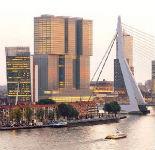
 International. The city of Rotterdam has a new urban icon, signed by the Dutch architect Rem Koolhaas and his office OMA, which houses an authentic "vertical city" of overwhelming dimensions and without equal architectural daring.
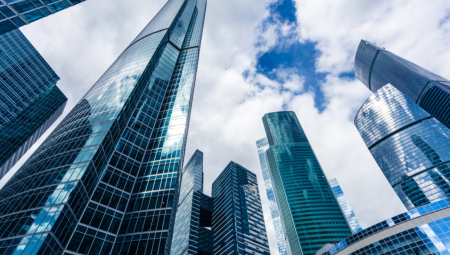
Its silhouette, which combines geometric aspects with asymmetrical elements, is distributed on a base of 30 meters high on which rise three towers of 150 meters high intertwined with each other.
Its 230 thousand tons of weight, 160 thousand square meters of interior space and its glass façade in which more than 50,000 square meters of that material have been used gives it an imposing and transparent appearance while competing in prominence with other skyscrapers of the renovated southern district of the port city.
The measures, erected on the banks of the Meuse River on an area equivalent to a football field, make the baptized as De Rotterdam an avant-garde architectural challenge that at first glance would seem impossible to realize.
The name of the De Rotterdam is reminiscent of the more port era of the rich south bank of the Meuse, referring to one of the ships of the famous transport company Holland America Line.
Founded in the late nineteenth century, that company, today in North American hands specialized in cruise ships, took waves of European emigrants to the other side of the ocean, with New York as the last destination.
The recent inauguration of the "vertical city" of Koolhaas has been possible thanks to the efforts of more than 4,500 people involved in the design and works, which lasted four years.
Although it will not open its doors until the beginning of 2014, it already has an 85% occupancy of its 240 apartments -for purchase and rent- and its 60,000 square meters of offices.
Like any self-respecting city, inside there will be a four-star hotel with 285 rooms of the Spanish chain NH, which will be dedicated to Dutch art and design.
Along with spatial efficiency and transparency, the new creation of Koolhaas estimates another of the principles of our time: respect for the environment of the essential energy sustainability.
What aspires to be one of the greenest buildings in the Netherlands uses energy from solar panels and wind turbines, as well as river water for cooling.