

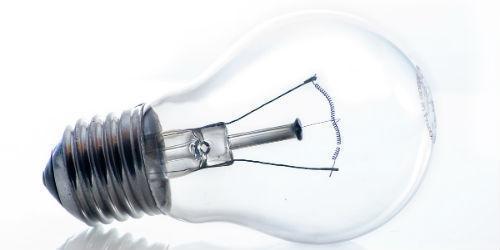
 International. The traditional incandescent bulb has been very useful since it was patented by Thomas Edison more than 130 years ago. But this high-temperature thermal emitter only takes advantage of a small fraction of its irradiated light, since most of it is emitted in the infrared, invisible to the human eye, and therefore, in this context, wasted.
This week researchers from the Massachusetts Institute of Technology (MIT, in the USA) describe in the journal Nature Nanotechnology a new methodology to recycle and adjust that infrared light, while optimizing that which is emitted at 'useful' visible wavelengths.
To demonstrate this, they have created an incandescent bulb of greater energy efficiency through special photonic nanostructures that filter the emitted light according to its wavelength, transmitting the visible and reflecting the infrared at a multitude of angles. As the filters are not in direct contact with the emitter, temperatures can be very high.
The researchers hope to apply the prototype they have developed so far to improve, in the future, the performance of hot thermal emitters, including thermophotovoltaic devices.