
 Latin America. Horizontal business models in offices allow for greater team interaction and collaboration and encourage flexible working.
Today, with the arrival of new generations in the labor market and the growing digital age, rigid and hierarchical organizational structures are being challenged by flatter and more horizontal management models. According to Humanscale, a pioneer and leader in the manufacture of ergonomic products for comfort at work, as millennials and intrapreneurs are integrated into offices, traditional hierarchical structures begin to dissolve. In response to this, some companies have removed layers of management that causes a transformation in workspaces for more autonomous and faster decision making.
Recent research reveals that while more than half of millennials globally believe that the most successful companies in the future will be those that incorporate innovative business models. This segment of professionals focuses more on who you are, what you do and how you behave, than on your title or place in the hierarchy.
This does not mean that a company dispenses with all its managers, but that new trends drive incremental changes for greater participation of teams in decision-making or the reduction of barriers in decision making. This point helps organizations to be more agile less hierarchical and more productive.
In this sense, what elements do companies take into account to adapt and transform their workspaces?
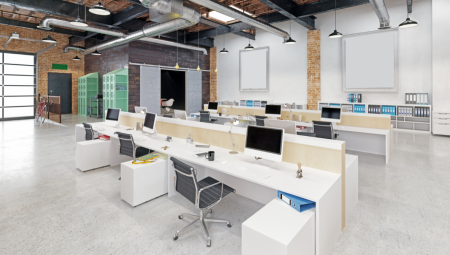
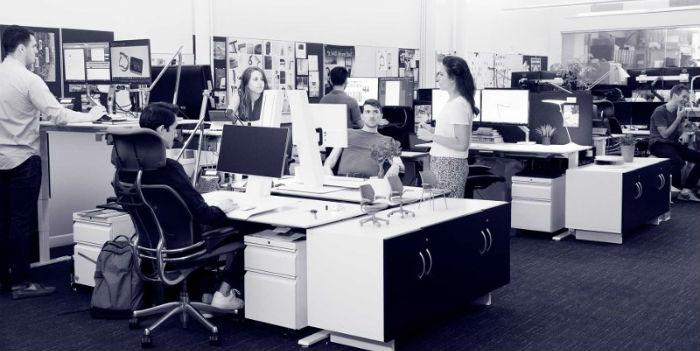
Horizontalization in offices allows for greater team interaction. Flexible and remote work is encouraged. Most startups start with a flatter structure. The challenge lies in keeping this configuration fluid once they grow. For smaller companies, this is an opportunity to stay efficient and fast, without adding unnecessary administrative processes.
"Design Thinking" is another important feature in the new offices. This concept allows to integrate all the work modalities in one place placing the user at the center of the transformation of the offices so in the end, there is less need to specifically build roles with little added value for the company.
Collaboration is another important factor. In a modern office there are fewer desks. Employees sit in "team zones" instead of assigned workstations so they can have quick conversations and interact with other areas of the business.
To facilitate the emergence of these collaborative spaces, Humanscale suggests the incorporation of the new QuickStand Under Desk tool, which allows users to seamlessly switch between sitting and standing postures without interrupting the workflow. The force mechanism for adjusting the height of the stand is inside a central column below the surface of the desk so that the views are not obstructed in the sitting position.
QuickStand Under Desk offers effortless functionality, an elegant design and is a discreet wellness solution that integrates into any environment and adjusts to users of different heights, offering stability when writing and supporting simple or dual monitors up to 16 Kilos, that way, everyone gets maximum visibility and interacts with people of different functions.
Finally, as artificial intelligence and automation are incorporated as work tools in organizations, teams must have more agile workspaces, where they can respond to maximize these technologies. Therefore, it is crucial to ensure that processes are optimized and have furniture solutions that adapt to new models.