
 Brazil. The title of Best Building in the World, awarded a few days ago when the second RIBA International Prize was awarded, surprised locals and strangers. And yet, this school that houses 540 children exemplifies "excellence in design and architectural ambition and offers a significant social impact", as defined by this biannual award that since 2015 replaces the Lubetkin and to which several dozen exceptional buildings built in the last three years aspired.
Considered the most rigorous architecture prize in the world, the international jury chaired by Liz Diller (DS+R) opted for an extraordinary project that had many ballots to go unnoticed in a world that sometimes looks too similar because it is always designed by them.
In this case, they were not big names but the studio founded in Curitiba by two thirty-somethings who took from Borges the infinity and nothingness of the number zero to change the lives of hundreds of kids who can not travel daily to go to school and show them that the knowledge of their ancestors, Updated with Science and Technology, they were worth more than the glow of glass, steel and air conditioning machines.
Eucalyptus earth and wood
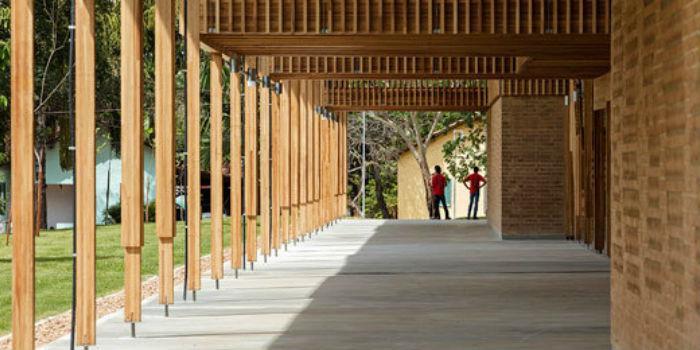
Challenged by its own location and limited by the scarcity of infrastructure, the Children's Village was built following local techniques -bricks made with the earth of the fazenda, floating walls like those of the traditional houses of the region-, pulling materials from the place itself, as well as with prefabricated elements assembled in situ.
The result, in which eucalyptus wood predominates, is an organic space with an area of almost 25,000 square meters organized in two identical complexes, one for girls and one for boys, which house rooms with three bunk beds, where before they slept up to 40. The perforated and breathable walls allow a natural cross ventilation, so there is no need for air conditioning to pass to temperatures rubbing 45ºC. Arranged around shaded patios, the first floor has flexible common spaces that house from hammocks to television and reading rooms.
And here, as in the book, the essential is invisible to the eyes. The Children's Village, in operation since 2016 thanks to the sponsorship of the Brandesco Foundation, is not only profitable and sustainable, but also responds to the community it serves and because of that sensitivity "to its local environment and its ability to respond to particular needs" is the best building in the world.