
 Let's get to know this project carried out in El Salvador that had the contribution of various automation and monitoring technologies.
by Reliable Controls
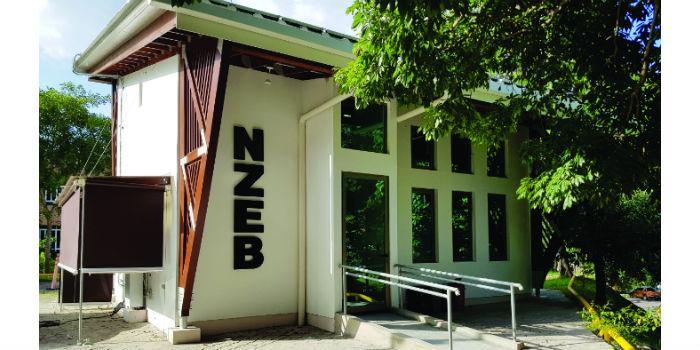
El Salvador recently inaugurated its first NET Zero Energy Building (NZEB), which in turn is also the first building of its kind in Central America. The building of the Universidad Centroamericana José Simeón Cañas (UCA) combines construction techniques, designs and materials that together with efficient air conditioning and lighting systems, make it a building with a high energy performance.
Additionally, it is completely controlled and monitored by a control and automation system that uses the BACnet protocol for the integration of air conditioning systems, lighting, energy monitoring, water, indoor and outdoor humidity and temperature conditions, air speed among others.
The building is built with a donation from USAID (United States Agency for International Development) in El Salvador, with the clear objective of promoting development in the region, betting on key projects related to higher education, the project is designed for USAID to donate approximately 50% of the value of the project, and promote invitations to collaborate with local companies that are interested in encouraging the development of the country from the management of their products and state-of-the-art technologies.
MP Service, S.A. de C.V., authorized dealer of Reliable Controls, made the donation of the automation and monitoring system composed of a powerful Mach-ProWebCom building controller, which in addition to functioning as a central controller, includes web server functions. This controller also includes Mach-ProPoint expansion modules and is linked with other Mach-ProZone zone controllers that are integrated using the BACnet protocol, all of which are reliably branded.
Additionally, the brand made a decisive support to the project by donating the RC-Studio engineering software that also works as an operator interface, RC-Archive for the management and storage of building performance data and RC-Reporter that allows the development and management of customized reports automatically.
Dr. Luis Aaron Martinez. Researcher and Head of the Department of Energy and Fluid Sciences. DCEF-UCA, promoted the project of the Net Zero Energy Buildings, and conceptualized the project of the building that will function as an experimentation laboratory.
Net Zero Energy Buildings
Net Zero Energy Buildings that, by definition, produce the energy required for their operation by renewable energy sources within the building's footprint. These buildings present the possibility of integrating sustainable technologies such as solar panels, electric vehicles and energy-efficient building systems and envelopes. Advanced controls enable optimization of energy consumption and optimal integration of renewable energy resources, energy storage and grid interaction.
The Central American University "José Simeón Cañas" has developed the NZEB-El Salvador research laboratory. The design was in charge of an interdisciplinary team of Engineers and Architects, both professors and students of the UCA. The laboratory has a construction area of 100 m2 and for its construction financing was obtained from USAID and Salvadoran private companies in the construction, air conditioning and control sectors.
NZEB-El Salvador is not only an instrumented laboratory that will provide real-time data on energy and thermal performance, it also opens the doors to a new integrative design methodology. It is also a didactic tool for academia and a measurement and testing instrument for industry.
It represents the opportunity for energy independence of non-renewable resources in a country where resources are scarce and opens the possibility of innovating and testing new technologies and materials. Among the technical characteristics included, we have:
1. Construction system and wooden structure (negative carbon emissions).
2. Thermal insulation of R-28 polyurethane foam throughout the envelope.
3. 14,175 kW photovoltaic solar system (4 Inverters).
4. The roof is inclined 13° to the south and the facades are inclined 10° north and 36° south.
5. 4 photovoltaic inverters that provide electrical energy and energy to the building and the electric vehicle.
6. The system includes a 10 kWh lithium battery energy storage system for research and load optimization purposes.
7. 74 measuring points with sensors in their service life:
• Weather station
• Illuminance meters
• Ambient and surface temperature meters along the envelope
• Water flow meters
• Relative humidity meters
• Carbon dioxide meters
• External and internal air velocity meters.
8. VRF type air conditioning system with 17 kW (5.83 tons of cooling) cooling capacity with two cassette units and one fan-coil. This system modulates the flow of refrigerant and controls the temperature while saving energy.
9. Lighting system with dimmable LED panels. Overall, the illumination power density (LPD) is 7.73 W/m2.
10. Both the air conditioning system and the lighting system are controlled by a building automation system that optimizes energy use. This system was donated by the company MP SERVICE, S.A. DE C.V. and Reliable Controls, allowing to regulate the levels of lighting and air conditioning according to the needs of the occupants, maintaining thermal comfort with a minimum energy consumption. This element is critical to achieving the expected high levels of efficiency.
11. The chosen electric vehicle has an 88 kW electric motor with a rated torque of 295 Nm, equipped with a lithium battery with storage capacity of 28 kWh. The nominal combined efficiency is 15.4 kWh / 100 km. The vehicle is expected to be used for experimental purposes and maintain a regime of at least 10,000 km per year.
Energy, thermal and flow (CFD) simulations were used in the design process, which predict that the building will generate 42% more energy annually than consumed, under typical operating assumptions, becoming a net positive energy building. When comparing with the energy efficiency standard ASHRAE 90.1-2013, an improvement of 41% was found, mainly due to the high level of thermal insulation and the advanced built-in automation system.