

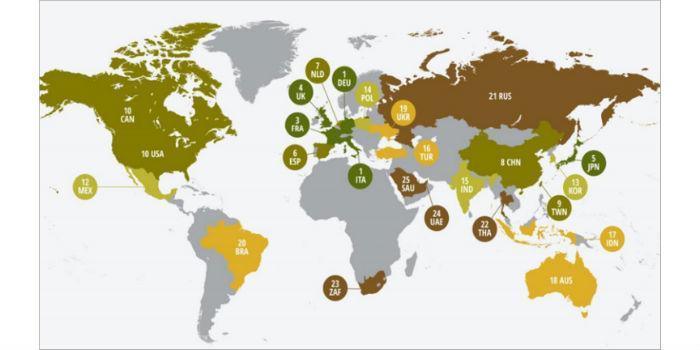
 International. Countries need to increase their energy efficiency indices to meet the goals of the Paris Agreement, according to the 2018 International Energy Efficiency Report published on June 26 by the American Council for an Energy-Efficient Economy (ACEEE). Germany and Italy tie for first place this year with 75.5 points. However, the average has remained the same as in 2016, 51 of the 100 possible points.
In its fourth edition, this biennial ranking studies the behavior of the 25 countries with the highest energy consumption by analyzing 36 efficiency indicators and highlights best practices for energy saving. For the first time, the ranking includes the United Arab Emirates and Ukraine.
Overall, Germany and Italy tie for first place this year with 75.5 points out of 100, followed closely by France (73.5), the United Kingdom (73) and Japan (67). The sixth place in the classification is occupied by Spain, with 65.5 points.
By sector, Germany has obtained the best score (22 out of 25) for national efforts, including cross-cutting objectives and programmes. Spain ranks first in building-related efforts, after scoring 22 points, while Japan leads in industry (21.5) and France in transport (17.5).
The country that has improved the most has been Mexico, which from the 19th position it occupied in 2016 has gone to 12th place by scoring 17 more points. The report indicates that behind this growth is the recent adoption in Mexico of a general energy efficiency program, the National Program for the Sustainable Use of Energy, which has stimulated investments in efficiency programs and standards.
In contrast, the United States has dropped from 8th to 10th, scoring six points less. ACEEE's senior research adviser, Shruti Vaidyanathan, has indicated that this trend is likely to persist if the current administration continues to dismantle key regulations.
The ACEEE report highlights that energy efficiency will need to account for nearly half of all greenhouse gas emission reductions needed until 2040 to limit global temperature rise to 2 degrees Celsius, according to the International Energy Agency.
To meet their climate goals and reap the multiple benefits of energy efficiency, this non-profit organization advises countries to incorporate efficiency into their economic and energy-related plans and recommends that they learn from each other by emulating the best policies and practices of leading countries.