
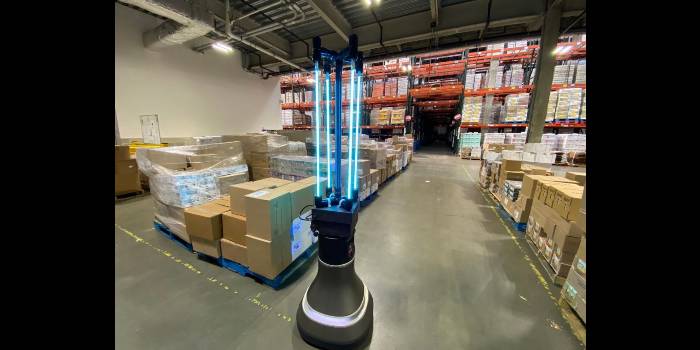
 United States. A team from MIT's Computer Science and Artificial Intelligence Laboratory (CSAIL), in collaboration with Ava Robotics and the Greater Boston Food Bank (GBFB), designed a new robotic system that powerfully disinfects surfaces and neutralizes aerosolized forms of the coronavirus.
The approach uses a custom UVC light lamp designed in CSAIL that is integrated with Ava Robotics' mobile robot base. The results were encouraging enough for the researchers to say the approach could be useful for autonomous UV disinfection in other settings, such as factories, restaurants and supermarkets.
UVC light has been shown to be effective in killing viruses and bacteria on surfaces and aerosols, but it is not safe for humans to be exposed. Fortunately, Ava's telepresence robot does not require human supervision. Instead of the telepresence top, the equipment was placed in a UVC matrix to disinfect surfaces. Specifically, the array uses short-wave ultraviolet light to kill microorganisms and disrupt their DNA in a process called "ultraviolet germicidal irradiation."
The complete robot system is capable of mapping the space, in this case, the GBFB warehouse, and navigating between waypoints and other specific areas. When testing the system, the team used a UVC dosimeter, which confirmed that the robot was delivering the expected dose of UVC light predicted by the model.
Food banks also face a particular demand due to the stress of Covid-19. The United Nations projected that, due to the virus, the number of people facing severe food insecurity worldwide could double to 265 million. In the United States alone, the five-week total of job losses has risen to 26 million, which may lead millions more to food insecurity.
During testing at GBFB, the robot was able to drive through pallets and storage aisles at a speed of about 0.22 miles per hour. At this speed, the robot could cover a 4,000-square-foot space in GBFB's warehouse in just half an hour. The dose of UVC administered during this time can neutralize approximately 90 percent of coronaviruses on surfaces. For many surfaces, this dose will be higher, resulting in greater neutralization of the virus.
Typically, this method of ultraviolet germicidal irradiation is mainly used in hospitals and medical settings, to sterilize patient rooms and stop the spread of microorganisms such as MRSA and C. diff, and UVC light also works against airborne pathogens. While it is most effective in direct "line of sight," it can reach nooks and crannies as light bounces off surfaces and other surfaces.
Keep clean
As a first step, the team teleoperated the robot to show it the way around the warehouse, meaning it is equipped with autonomy to move around, without the team having to navigate it remotely.
You can go to landmarks defined on your map, such as going to the loading dock, then to the warehouse shipping floor, and then back to the base. They define those waypoints from the expert human user in teleop mode and can then add new waypoints to the map as needed.
Within GBFB, the team identified the warehouse shipping floor as an "area of great importance" for robot disinfection. Each day, workers organize the product aisles and organize them for partners and distribution trucks to pick up up up to 50 people the next day. By focusing on the shipping area, it prioritizes disinfecting items leaving the warehouse to reduce the spread of Covid-19 in the community.
Currently, the team is exploring how to use its built-in sensors to adapt to changes in the environment, so that in new territory, the robot will adjust its speed to ensure that the recommended dose is applied to new objects and surfaces.
A unique challenge is that the shipping area is constantly changing, so every night, the robot encounters a slightly new environment. When the robot is deployed, it doesn't necessarily know which of the aisles will be busy or how full each aisle can be. Therefore, the team notes that they must teach the robot to differentiate between busy and unoccupied aisles, so that it can change its planned route accordingly.
Source: MIT.