
 International. The danger of becoming infected with the coronavirus is especially high in enclosed spaces. This is because aerosols, which play a key role in the transmission of COVID-19, increase the concentration of SARS-CoV-2 in indoor spaces. A new ventilation system developed by two Fraunhofer Institutes can filter the virus from the ambient air. It then destroys the virus in a process known as cold combustion, leaving only small amounts of carbon dioxide and hydrogen.
With the passing of the days, the lives of many have returned to the interior and, with it, the danger of contracting the coronavirus in schools, offices and shopping centers. A ventilator that reduces the danger of infection could play an important role in the fight against the coronavirus. In a project known as CoClean-up, the Fraunhofer Institute for Ceramic Technologies and Systems IKTS in Dresden and the Fraunhofer Institute for Toxicology and Experimental Medicine ITEM in Hannover have now developed such a solution. This new system filters pathogens from the ambient air and destroys them, leaving nothing but the non-toxic gas CO2.
The study indicates that while filtering systems already exist that clean the ambient air, they simply capture the virus rather than destroy it. Failure to change the filter can result in a puncture in the used filter, which in turn can lead to a major discharge of the virus into the room. Filter swapping can also pose problems. What is the best way to remove the worn filter and then dispose of it safely along with its virus load? UV filters are an alternative. These destroy most of the virus, but the process involved can often create other harmful substances. In other words, they offer a partial solution at best.
The researchers say that at first glance, there is little to distinguish the Fraunhofer fan from existing systems, but the process behind it, however, is completely new. "Our ventilation system completely destroys viruses and any other organic material," says Hans-Jürgen Friedrich, group manager at Fraunhofer IKTS. "All that remains are small amounts of CO2 and hydrogen. In other words, our process really eliminates the coronavirus."
The virus oxidizes to CO2
Instead of the filter found in conventional fans, the new system uses a cold combustion process to eliminate the virus. The ambient air is fed through a saline solution, which filters the virus and any other organic particles. The clean air is then returned to the room. In the saline solution there are two electrodes, through which a voltage is applied. In an electrode, organic substances from the saline solution, including viruses, are completely oxidized to form CO2, in a process also known as cold combustion; in the other, small amounts of hydrogen are produced. In a normal-sized room containing a considerable number of people, this would only produce a couple hundred milliliters of CO2 and hydrogen over the course of several hours. These two gases are then dispersed throughout the air inside the room. For comparison, each liter of air exhaled by a person, the equivalent of a breath, contains about 40 milliliters of CO2.
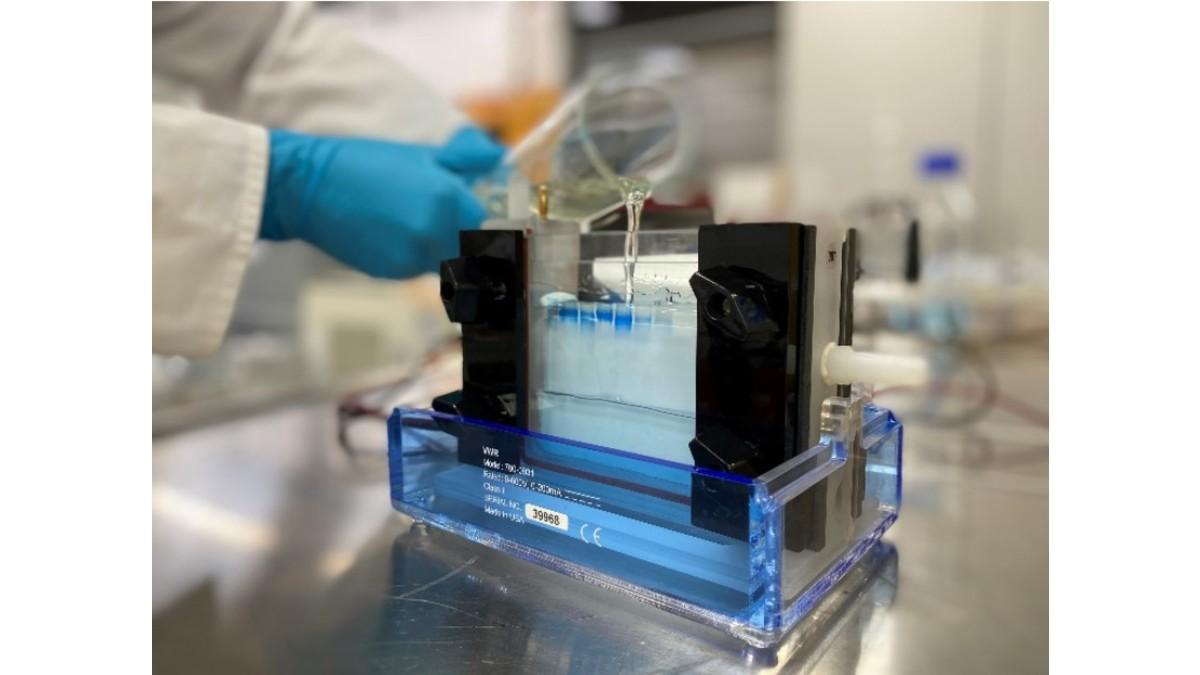
Currently, research teams are conducting tests with harmless substances. "For safety reasons, we do not use the actual coronavirus for testing," explains Dr. Katharina Schwarz, department head of Fraunhofer ITEM. "Instead, we use substitutes with very similar properties." In the tests at Fraunhofer IKTS, these substitutes were added directly to the saline solution. The researchers then analyzed the breakdown of this biological material on the electrodes and measured how much was left in the clean air discharged by the system. This showed that the various electrolytic processes, i.e. the key part of the system, work as needed.
In further tests, the researchers will create an aerosol loaded with the virus and pump it into the saline solution. Here they will also use less harmful substitutes. "As far as I know, there is no standardized procedure anywhere in Europe for using an airborne aerosol from a dangerous virus in order to test the effectiveness of air purification and disinfection systems," Schwarz says.
Taking a closer look at aerosols
In another Fraunhofer-Gesellschaft-funded project, Schwarz is working with healthy test subjects to investigate how the aerosol composition of exhaled air changes based on whether the person breathes normally or speaks, coughs and sings. Equipped with this knowledge, she plans to produce different types of aerosols, which will then be loaded with the virus and introduced into the electrolytic cell. "But we need to be careful that artificially produced aerosols don't damage or break down the test viruses," he explains. "The key is to find a good balance."
The fan developed for CoClean-up will be unveiled as a demonstrator at the conclusion of the project in April 2021. It would take another 18 months or so before the system is ready for market launch and meets regulatory requirements. In addition to the coronavirus, the ventilator could also be used to filter other pollutants into the air, such as cattle viruses or swine and bird flu.
Fraunhofer IKTS is currently investigating other options for the removal of pollutants in the air. "But there aren't many other ways to deal with this kind of problem that just leave you with CO2 in the end," Friedrich explains. "Our method has great potential, and not just for the coronavirus."
Source: Fraunhofer Institute.