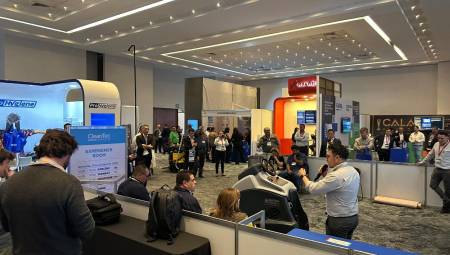

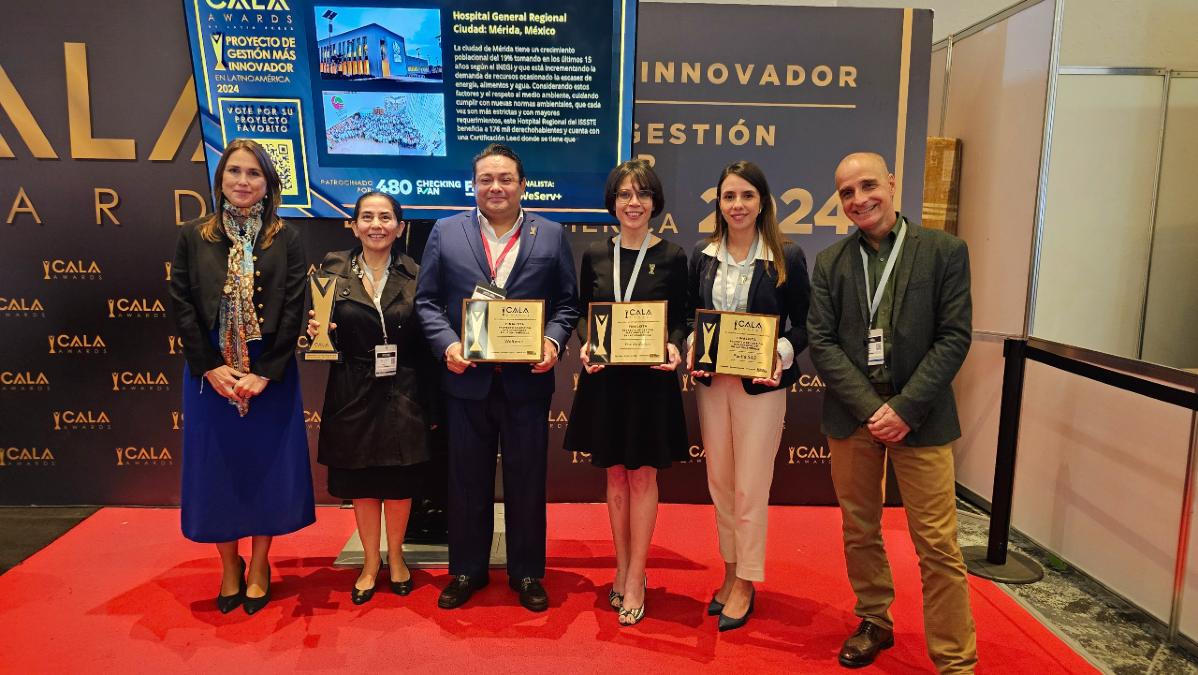
Mexico. WeServ+ was chosen by the public as the winner of the CALA Awards for the Most Innovative Management Project in Latam 2024, a ceremony that was held within the framework of the TecnoEdificios Congress on October 9 at the World Trade Center in Mexico City.
The CALA Awards was sponsored by the company Cuatroochenta and its brands FAMA and Checking Plan.
The other two finalists also participated in the ceremony: Pactia and Gantenbein, who, together with WeServ+, were also part of a panel to publicize their projects and to talk more about the landscape of the Faciliy Management industry.
About the winning project
WeServ+ executed a project for the ISSSTE Regional Hospital in Mérida, Mexico, which benefits 176 thousand beneficiaries and has a LEED Certification where the environmental impact has to be reduced (Water, among others), where the operation of the hospital also has an IS0 14001 Certification.
 The objective of this project is to comply with the LEED and ISO 14001 recertifications, where WeServ+ contributed with the reduction of water to 60% in cleaning services. "At WeServ+ we adapt to the trends of sustainable cleaning or "green cleanning". In our Cleaning, Disinfection and Waste Management Service, we employ a methodology, accompanied by technology, equipment and tools, which aim to drastically reduce water use, improve cleaning performance, improve cleaning conditions and support the health of patients and employees," explains the company.
Context before improvements
Hospital with a total construction area of 19,652m2 of which 13,824m2 are areas to be cleaned, the hospital has different types of spaces and each one has different cleaning frequencies, either by defined programs or the demand of use, we cannot share the breakdown due to confidentiality issues with the client. Let's use an average of 120 spaces to be cleaned daily between bathrooms, operating rooms, offices, corridors, etc., divided by the m2 to be cleaned mentioned above. Where conventional mopping and cleaning with flannel cloth were used, where for this procedure 2 buckets of 20 liters with 50% water (20 liters in total) were used, this gives us an average of 2,400 L; now we have to take into account that the hospital on average is cleaned 2 times a day; in total, this would give us 4,800 L per day. If we take that this hospital, being a regional area hospital, operates 24/7, 365 days a year, the annual water use was 1,752,000L (4,800 x 365 = 1,752,000).
Currently the process is through three main elements:
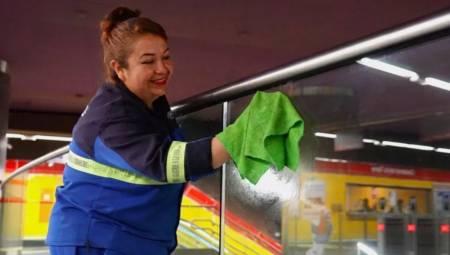
1. Cleaning method: based on the use of microfiber (mops and cloths), which absorbs up to 7 times its weight, leaves no residue compared to the previous procedure, requires a low amount of cleaning product and its useful life is longer. Similarly, microfiber mops and cloths are identified with colors for each type of surface to be cleaned, which helps avoid cross-contamination.
2. Product platform: multipurpose chemicals – super concentrated disinfectants with a controlled dilution system, which reduces the use of plastic for packaging, reduces chemical waste due to handling and personnel do not make mistakes in the preparation of dilutions and guarantee cleaning and disinfection with the use of these.
3. Professional tools and equipment: the cleaning staff has a cleaning cart configured for better performance which, by having a reduced portfolio of chemicals and microfiber mops and cloths identified for each surface and ergonomic telescopic cane, brooms to collect garbage once accumulated by the mop and/or perform a quick floor wash and dusters for cleaning grids, It eliminates the double-bucket system, prevents cross-contamination, and reduces time and water waste, while minimizing the environmental footprint.
Currently, 608,256 L per year are used to dilute the DIRVERSEY products we currently use and 82,944 L to clean the microfibers and mops to clean the entire hospital, saving 1,036,800 L per year. Saving 60% less water per year.
It should be noted that applying this methodology does not require the use of the double bucket technique to carry out cleaning, only the buckets are used for washing and disinfecting the material. This also creates a unique technique which allows us to apply this methodology in critical and semi-critical areas, although taking special care in the elements that exist in each of these areas.
Profitability
The investment was approximately USD$10,000 which can generate a reduction in personnel between 7% and 10%.
Results
LEED and ISO 14001 recertifications were achieved, in addition to minimizing the risk of cross-contamination, considerable decrease in water consumption (no double bucket technique is used). The durability of the materials (Mops up to 6 months of useful life) and 10% of the personnel was reduced.
Positive impact on customer management processes
The client thanked the support in the Recertification processes, since a large percentage was contributed to the reduction of the hospital's water use in its total operation; nosocomial diseases were minimized, the image in the provision of the cleaning service was improved, in addition to contributing with a novel system and use of technology in sustainable products.